
Because Every Conversation Has a Receiver



Every professional conversation has two people in it.
The one doing the talking. And the one whose brain is deciding, in milliseconds, whether it is safe to keep listening.
The world has invested heavily in the first person. Better presentations. Stronger pitches. More training on how to say what we want to say.


The second person - the receiver, the one whose brain runs a check before logic ever engages - has been largely left out.
That is the gap DECODED was built around.
Not a tool. Not a product announcement. A point of view. The most important moment in any professional conversation is not what the sender says. It is what happens in the receiver's brain when they hear it.
The most important moment in any professional conversation is not what the sender says. It is what happens in the receiver's brain when they hear it.
This matters in selling. In organizational change. In company culture. In stepping into a leadership role. In learning and development. In every professional context where conversation quality determines what happens next.
If you work in any of those worlds, you have felt this gap. You may not have had words for it yet.

Scroll down. Find your world. See if this is talking your language.
For the Seller
For the Change Practitioner
For the Culture Builder
For the New Supervisor
For the L&D Professional
You are good at what you do. You know your offering. You believe in it.
And you have had more conversations than you can count with people who seemed interested right up until they weren't.
They went quiet. They said they'd circle back. They stopped responding. And you replayed the conversation trying to find the moment it turned.
Here is what most sellers are never told.
The person across from you was not evaluating your pitch. They were evaluating whether it felt safe to keep listening. That evaluation happened in milliseconds, before logic, before interest, before they consciously decided anything.
Most sales training teaches you to be a better sender.
Nobody trains you for the brain on the other side of your words.
You have done this before. You know what a well-designed initiative looks like. You have the methodology, the stakeholder map, the communication plan.
And still, somewhere in the middle of it, the people start to drift.
The sponsor gets harder to reach. The middle layer goes quiet. The energy that was there at launch quietly evaporates. You find yourself re-explaining things that were already decided and having conversations you thought were behind you.
Every change framework covers the process. What none of them cover is what is actually happening inside the conversation between you and the human being at the other end of each stage. The one whose brain is running its own evaluation, in real time, about whether this change is something they will move toward or quietly wait out.
Most change training teaches you to design the initiative.
Nobody trains you for the receiver sitting across from you at every stage of it.
You can see it. You have probably been able to see it for a while.
The dynamic that keeps repeating. The conversation that circles without landing. The room that nods and does not move. You have named it. You have reframed it. You have brought in processes and workshops and off-sites.
And the culture has not shifted the way you expected.
Here is why. Culture does not live in programs. It lives in conversations. Specifically, in what happens inside the people having them, what their brain decides is safe to say, what it decides to keep to themselves, what it does with what they hear before they respond.
Most culture work teaches you to diagnose the problem.
Nobody trains you to think from the receiver's side of the conversations that create it.
You earned this role. You were good at the work, and now you are responsible for the people doing it.
And you have discovered something nobody fully prepares you for: being excellent at the subject and being effective with the humans who report to you are two completely different things.
Every conversation with your team now carries weight it did not carry before. The way you give feedback. The way you handle the person who pushes back. The way you show up for someone who is struggling. Each of those moments is forming something - a relationship, a reputation, a level of trust that will either grow or quietly erode.
Whether you are six months in or three years in, this is the right time to be thinking about it.
Most supervisory development teaches you about the role.
Nobody trains you to think about what each person's brain is doing with what you say to them.
You built your career knowing the subject better than almost anyone. You were the one people came to when they needed to understand it.
Now you are responsible for how other people learn it.
And you are discovering that those are two completely different things. Knowing something deeply does not automatically transfer into designing for how someone else receives it. You still feel like the deliverer. The role is now asking you to think like the person on the other side. That shift is harder than anyone told you it would be, and there is almost no language for navigating it, let alone support for actually making it.
Most L&D training teaches you to master the content.
Nobody trains you to think from the learner's brain outward.
What All Five In Common
Different professions.
Different rooms. Different pressures.
Same gap.
Every one of those frustrations traces back to the same root: the world trained you to be a better sender. To prepare more carefully, communicate more clearly, structure more confidently.
Nobody built anything for the receiver's side of the conversation.
Not because it does not matter. Because it is harder to see. The sender controls the preparation. The receiver's brain operates outside your view — making decisions about safety, relevance, and trust before conscious thought even engages.
That gap has always existed. What is changing is the context around it.
For years, the ask was simple: give us better tools, and we will have more time for the things that actually matter.
So we invested. We automated the repetitive work. We built systems to handle the low-stakes, high-volume tasks that were eating everyone's days. And in a lot of organizations, it worked. AI delivered what it said it would. The mundane got handled. The capacity opened up.
And then something unexpected happened.
We woke up with more time and discovered that more time does not automatically make us better at the thing we now had more time for.
The thing nobody scheduled. The thing no productivity tool has ever been able to handle. The conversation. The room with another human being in it. The moment where what you say (and more importantly, how it lands in the brain on the other side) determines whether anything actually moves forward.
AI cleared the path. The path leads straight to the most human activity there is.


AI cleared the path. The path leads straight to the most human activity there is.
The first generation of AI was built around the sender. More output. Faster. More polished. The question it answered was: how do we produce more?
The question it left completely untouched: how do we make sure what we produce actually lands?
That is the question DECODED is built around. Not instead of AI, alongside it. Because the receiver's brain has not changed. It still runs the same check it has always run. And now that so much of the noise has been cleared away, that check is the most important variable left.
The Starting Point
In every conversation, there is a receiver's brain.
That brain deserves to be at the center of how we think about communication, not as the audience for content we have already designed, but as the starting point for everything.
DECODED is a neuroscience communication company built on that conviction. The work grew out of real rooms across selling, organizational change, company culture, supervisory development, and learning and development, covering decades of watching what actually happens in the space between the sender's intent and the receiver's response.
The neuroscience gave that experience a vocabulary. Purpose-built thought partners, one for each professional conversation domain, put it in the hands of practitioners who need it at the moment a real conversation is in front of them. The human stays at the center. The thinking happens together. The output belongs to the practitioner who walks into the room.
This is not a tool that talks at you.
This is a Thought Partner that thinks with you.
What Is a Thought Partner, and How Is This Different from Generic AI?
Five ingredients. Like a loaf of bread. Leave one out and what you get is something far from bread. Here is the DECODED Thought Partner "recipe."
1. A collection of specialized agents, each built to go deep in a specific moment within a specific professional domain. Not one agent that does a little bit of everything. Many agents, each with a precise purpose, so the thinking at every stage of a conversation is as sharp as the moment demands.
2. Curated knowledge drawn from proven frameworks and published works. Not pulled from the open internet. The Thought Partner activates this knowledge base and stays within it. That is what creates consistency, eliminates hallucination, and makes the guidance trustworthy rather than approximate.
3. Two layers of context. Company context: what you do, how you position it, how you go to market. User context: who you are, how you think, how you communicate, each brough into the recipe so the Thought Partner complements your style rather than overriding it.
4. A language model as the engine. The technology that brings the agents, the knowledge, and the context together into a single responsive conversation.
5. Neuroscience as the filter. Specifically, the receiver perspective. Everything the Thought Partner produces is shaped by one question: how will this land in the brain on the other side?
That combination is what makes a DECODED Thought Partner different from asking a general AI assistant the same question.
The ingredients are different. The output is different. And the human stays at the center of it throughout.

"I have spent a long time in rooms where the right conversation did not happen. Not because people did not care, but because nobody had been trained to think about the person on the other side of their words. That is what I built The DECODED Mind around. Keeping the Human in the Loop in a world of AI explosion."
— Patrick Seaton, Founder
Let's Talk
This page is the beginning of a conversation, not the end of one.
If something here landed for you, if you recognized your own frustration in one of those sections, or if the receiver's brain framing put words to something you have been living, I want to hear about it.
Not to pitch you. Not to run you through an intake process. To have a human-to-human conversation about the need for human-to-human conversations in your world, in your vertical, in the middle of everything AI is changing.
Because here is something else that may be true across almost every one of those verticals: you might be doing this alone. You might be the only person on your L&D team. You might be the principal driver of a change initiative, the one everyone is counting on to make it move, with no one really in it alongside you. Or you might be the one expected to make a "better" culture a reality, knowing that you cannot actually make it happen yourself. Every department, every team, every individual conversation has to do that. Your job is to make all of them ready and willing. That is a particular kind of alone. You might be the new supervisor with other supervisors around you but no one actually in your corner. You might be the solopreneur who knows their domain inside and out and has nobody to think out loud with before the conversation that matters.
That kind of alone has a name. It is the absence of a thought partner.
If the idea of a thought partner built specifically for your domain sounds like something worth exploring, I want to know what you would want it to do. What conversation would you bring to it first?
You do not need to have it figured out. You do not need a perfect answer. The only question that matters right now is: does this resonate? Does this feel like a gap you recognize in your world? That is enough to start.
Raise your hand. Tell me what your world looks like. We will take it from there.
Patrick Seaton will respond directly.
The DECODED Mind Download
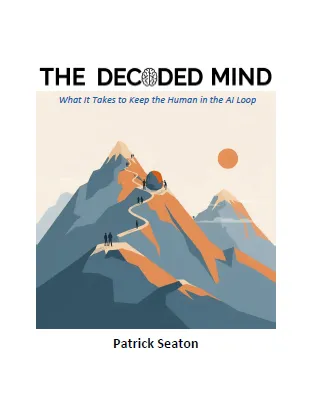
The DECODED Mind, What It Takes to Keep the Human in the AI Loop is now available for purchase and download. Click on the Buy Now button. Only US$19
Book summary: AI gave us more time. More output. More efficiency. And then a quieter question started forming: why haven't the conversations that actually matter gotten any better?
The DECODED Mind explores the gap the first wave left behind, and the path to the second mountain.

Thought Partners in the DECODED Portfolio
Where things stand today
AskAlex™ — Sales Thought Partner
Ready now. Visit: askalex.coach
OSCAR™ — Organizational Change Thought Partner
In development.
Challenge™ — Company Culture Thought Partner
In development.
SAGE™ — New Supervisor Thought Partner
In development.
FOUNDATIONS™ — Learning & Development Thought Partner
In development.
This list will grow. Check back.

DECODED | Innovative Management Tools LLC
Patrick Seaton, Founder
TheDecodedMind.com
© 2026 Innovative Management Tools LLC | All rights reserved.
Because Every Conversation Has a Receiver.